

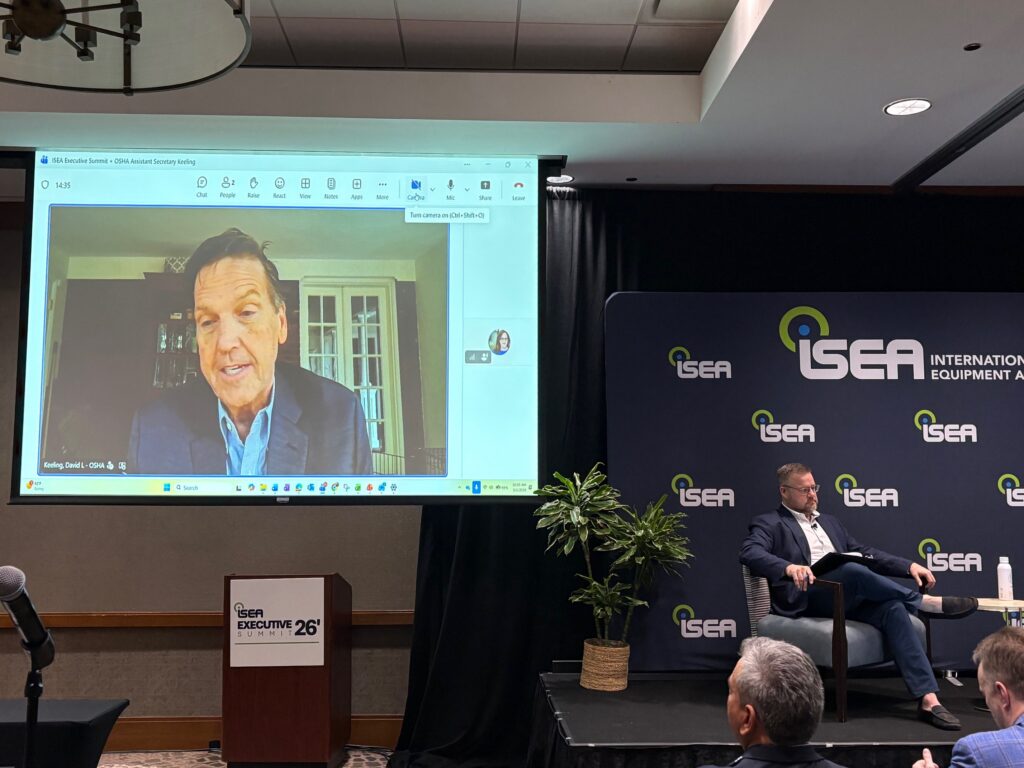
We had the opportunity to hear from OSHA Assistant Secretary David Keeling during the ISEA Executive Summit on May 1. He joined us virtually (while juggling his travel schedule), and we’re grateful he made the time for a candid, forward-looking conversation.
If you missed it, here are the biggest ideas you need to know.
1. OSHA Is Rebranding: From Enforcer to Partner
One of the clearest themes: OSHA wants to shift how it’s perceived.
Yes, enforcement still matters—but Keeling emphasized that it’s “just one club in the bag.” The bigger goal? Becoming a resource companies want to engage with—not one they fear.
The reality, as he put it:
- Most employers (he estimates ~95–97%) want to do the right thing
- Many just need guidance, tools, or support to get there
Expect OSHA to lean more into:
- Mentorship and compliance assistance
- Programs like OSHA Cares and Safety Champions
- Earlier, more collaborative engagement with industry
2. Enforcement Isn’t Going Away—But It’s Getting Smarter
OSHA isn’t backing off on enforcement.
Instead, it’s getting more targeted.
Keeling called out a small group of systemic bad actors who repeatedly skirt rules. OSHA is standing up a dedicated effort to address them.
At the same time, there’s a shift in philosophy:
- Less focus on citations for their own sake
- More focus on abatement and real-world fixes
- Creative approaches—like allowing employers to use funds to abate a hazard rather than pay a fine.
That’s a meaningful change for employers, especially small and mid-sized businesses.
3. Data, Not Just Regulations, Will Drive the Future
Keeling didn’t hold back here: traditional safety data is too slow.
BLS data is useful, but Keeling also wants to focus on technology-driven leading indicators
OSHA is moving toward:
- Predictive analytics
- Real-time insights
- More proactive hazard identification
This signals a bigger shift:
From reacting to incidents -> To anticipating and preventing them.
For the industry, that opens the door for innovation—especially in tech, AI, and connected safety solutions.
4. The Scope of “Safety” Is Expanding Fast
Keeling highlighted a few emerging and continued focus areas:
- Mental health
- Workplace violence
- Opioid response and Naloxone access
- Heat stress and worker preparedness
- Energy Control & Lockout / Tagout
His message was blunt: employers can’t “wall themselves off” from societal issues anymore. What affects society affects the workplace.
Expect OSHA to:
- Lean into education and prevention
- Partner across agencies
- Engage earlier—even before workers enter the workforce
5. Safety Has to Be Built Into Culture—Not Sit Beside It
Keeling challenged the idea of “safety culture” as a separate thing.
His argument: If safety sits outside your organizational culture, it will always lose to it.
Instead:
- Safety must be embedded into how the business operates
- It cannot be a competing priority
- If you can point to one person who “owns safety,” you’ve already got a problem
This is especially critical for:
- Smaller businesses
- Companies where production pressures compete with safety
Bonus: Big Opportunities for Industry
Keeling made it clear—OSHA can’t do this alone.
He called on groups like ISEA and the broader safety ecosystem to help:
- Share innovation and new technologies
- Educate on issues like counterfeit PPE
- Collaborate earlier in the regulatory process
- Help scale impact beyond OSHA’s limited resources
His framing was simple: OSHA has ~1,500–1,800 people. Industry has thousands.
That’s where real change happens.