

Herbert Post, VP Safety and Health at TRADESAFE
A lockout device can satisfy the catalog description, meet OSHA’s basic device requirements, and still fail when it reaches the valve, breaker, or isolation point it was supposed to control.
That is the gap many hazardous energy control programs underestimate. OSHA 29 CFR 1910.147 establishes minimum performance requirements for controlling hazardous energy during servicing and maintenance, but it does not operate as a device-by-device selection manual for every machine configuration, environment, or maintenance condition. The central issue is not whether a lock, tag, or valve cover appears compliant in isolation. The issue is whether the selected device can be applied consistently, hold the energy-isolating device in the safe state, survive the environment, and support verification under real field conditions.
What OSHA 1910.147 Actually Requires for Lockout/Tagout Devices and Procedures
OSHA 1910.147 addresses both the characteristics of the lockout/tagout device and the way hazardous energy control procedures are executed. Treating those as the same requirement is where selection errors often begin.
Under 1910.147(c)(5), employers must provide locks, tags, self-locking fasteners, or other hardware for isolating, securing, or blocking machines and equipment from energy sources. Lockout and tagout devices must be singularly identified, used only for energy control, and meet requirements for durability, standardization, substantiality, and employee identification. The table below shows what the OSHA standard requires.
OSHA requirement area | What the standard requires |
Durability | Devices must withstand the expected environment; tags must remain legible in wet, damp, weather-exposed, or corrosive conditions. |
Standardization | Devices must be standardized within the facility by at least color, shape, or size; tags must also be standardized by print and format. |
Substantiality | Lockout devices must resist removal without excessive force or unusual techniques; tagout attachments must have a minimum unlocking strength of at least 50 pounds. |
Identifiable | Lockout devices and tagout devices must be able to identify the employee who applied them. |
OSHA 1910.147(d) then moves from hardware to application. The energy control procedure must follow a sequence:
- Preparation for shutdown
- Machine or equipment shutdown
- Isolation
- Application of lockout or tagout devices
- Control of stored or residual energy
- Verification of isolation before work begins
Where an energy-isolating device is capable of being locked out, OSHA expects lockout to be used unless the employer can demonstrate that a tagout system provides full employee protection. Tagout is not simply a lower-cost substitute for a lock; when used in place of lockout, it may require additional protective measures and must be evaluated against the standard.
In other words, device characteristics describe the minimum qualities of the hardware, while hazardous energy control depends on whether that hardware performs correctly on the actual equipment.
Persistent Lockout/Tagout Failures
Even though OSHA has a clear standard, lockout/tagout failures remain persistent. Recent enforcement trends show that hazardous energy control remains a recurring problem:
- FY 2023: Lockout/tagout ranked No. 6 among OSHA’s most frequently cited standards.
- FY 2024: OSHA’s commonly used statistics placed Control of Hazardous Energy at No. 3.
- FY 2025: OSHA’s Top 10 list placed Control of Hazardous Energy at No. 4.
The industry concentration is even more telling. OSHA’s FY 2025 industry profile for 1910.147 shows 2,549 federal citations across all industries, with the three manufacturing NAICS sectors accounting for 1,997 citations, or about 78%.
That concentration reflects industrial reality: multiple energy sources, frequent maintenance interventions, production pressure, sanitation work, troubleshooting, contractor activity, and equipment modifications that may outpace procedure updates. The pattern is not isolated, and it is not resolved by buying devices that appear compliant on a purchasing checklist.
Where Failures Actually Occur in Practice
Most lockout/tagout failures show up during maintenance, service, or troubleshooting. The cause, however, is often created earlier during selection, procedure development, training, or inspection.
NIOSH’s review of 152 lockout/tagout-related fatalities investigated through the Fatality Assessment and Control Evaluation program identified three major contributing factors: failure to deenergize, block, or dissipate energy sources in 82% of incidents; failure to lockout and tagout energy isolation devices after deenergization in 11%; and failure to verify deenergization before work in 7%.
The primary failure categories are straightforward:
- No lockout: work begins without physically controlling the energy-isolating device.
- Incomplete lockout: some energy sources are isolated while others remain active, stored, or capable of reaccumulation.
- Poor verification: employees assume isolation has occurred instead of confirming a zero-energy state before exposure.
Those failures are not purely behavioral. They are often reinforced by device choices that do not match field conditions. Some examples:
Field failure point | How it appears during work |
Incompatibility with isolation points | The device does not fit the actual breaker, valve, disconnect, plug, or actuator without forcing or improvising. |
Inability to hold the safe state | Handle, switch, or valve can still move partially after the device is applied. |
Environmental degradation | Tags fade, plastic becomes brittle, metal corrodes, or labels lose legibility. |
Inconsistent application | Different shifts or contractors use different devices for the same isolation point. |
Weak verification practices | A lock is applied, but no one confirms zero energy or stored energy release. |
This is the practical distinction at the center of the issue: a compliant device is not the same as an effective control.
Limitations of Device Selection as a System Decision
Lockout/tagout device selection fails when organizations standardize purchasing before they standardize control requirements. The energy control procedure should determine which device is approved for each isolation point. Once procurement substitutions begin overriding validated field compatibility, consistency erodes and improvisation increases.
Equipment configuration drives selection. A disconnect switch, breaker, plug, gate valve, pneumatic isolation valve, hydraulic block, or steam line may each require a different method of control. Energy type also matters. Electrical, mechanical, hydraulic, pneumatic, chemical, thermal, gravity, and stored pressure hazards do not behave the same way after shutdown.
Selection also breaks down when purchasing logic overrides field validation. A lockout/tagout device may be treated as interchangeable because it falls within the same product category, comes from an approved supplier, or appears equivalent on a specification sheet. In the field, small differences in shackle clearance, cable stiffness, valve-cover geometry, breaker compatibility, tag material, or attachment strength can determine whether the device actually restrains the energy-isolating device.
OSHA interpretation letters reinforce this functional view. In one pneumatic valve case, OSHA stated that locking disconnected pneumatic tubing was not acceptable because the valve, in that configuration, did not meet the definition of an energy-isolating device capable of being locked out. The issue was not whether a lock could be attached somewhere. The issue was whether the method actually controlled the energy-isolating device without dismantling or relying on a workaround.
The implication is direct: apparent compliance can mask a functional gap. The device must control the energy-isolating device, not merely signal intent.
Making Lockout/Tagout Device Selection Work in Practice
Reliable selection comes from integrating device decisions into the energy control system. The goal is not to purchase another set of compliant lockout products. The goal is controlled compatibility across equipment, tasks, and environments.
Selection Criteria
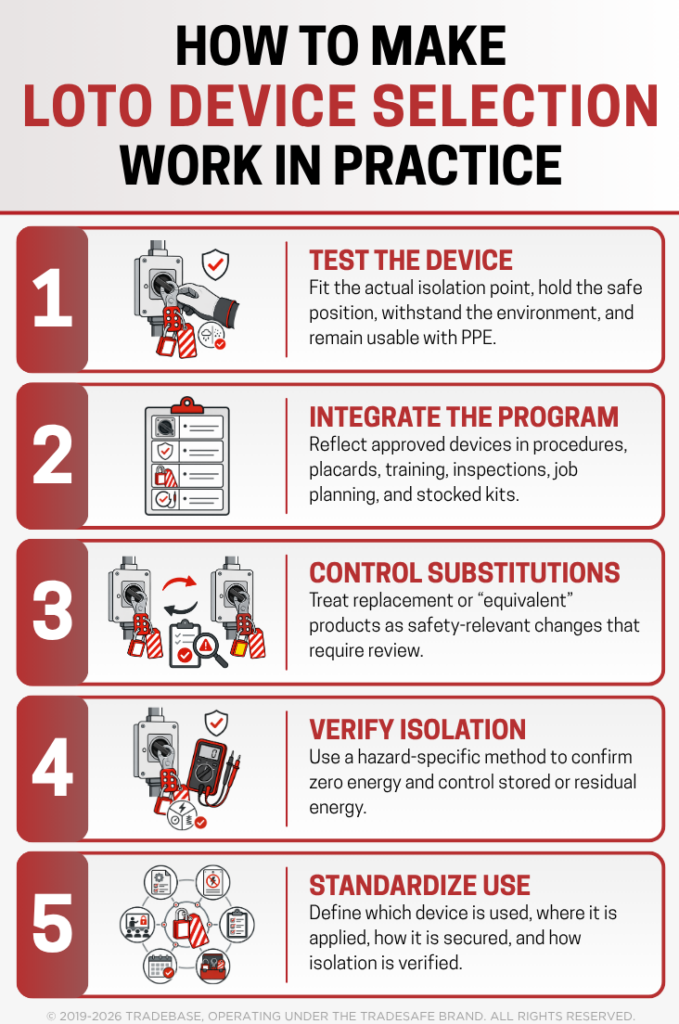
Selection should be tested against four practical criteria:
- Compatibility: the device must fit the actual isolation point without forcing, modifying, or relying on improvised attachments.
- Restraint: it must hold the energy-isolating device in the safe or off position, with no practical movement that could reintroduce hazardous energy.
- Environmental suitability: materials must withstand moisture, chemicals, UV exposure, cold, heat, abrasion, and cleaning agents for the expected exposure period.
- Usability: an authorized employee wearing normal PPE must be able to apply the device correctly in the available space.
In practice, these criteria should be checked against the equipment as installed, not only against catalog descriptions or general equipment categories.
Program Integration
Approved devices should be reflected in written procedures, lockout placards, job planning systems, training materials, inspection checklists, and stocked lockout kits. Training must also include selection judgment. Authorized employees should practice with the actual devices and isolation points they will use, not only classroom examples. They should be able to:
- Recognize when a device almost fits
- When a tag is being used where lockout is required
- When a control switch is being mistaken for an energy-isolating device
- When a job should stop because the procedure and field conditions do not match
Inspection should test the system. OSHA requires periodic inspection of energy control procedures at least annually. However, too many of these inspections only confirm that procedures exist without confirming that isolation methods still work on the equipment as installed. Effective inspections evaluate whether approved devices are still compatible with the modified machinery, replacement components, environmental exposure, and actual maintenance practices.
Procurement Controls
Procurement should not substitute “equivalent” products without a safety review. A product considered “equivalent” for purchasing purposes may not be operationally appropriate at the isolation point.
Facilities should treat procurement substitutions as safety-relevant changes. Before a new or replacement device is approved, the employer should confirm that the device:
- Fits the actual isolation point
- Holds the energy-isolating device in the safe or off position
- Can be applied by an authorized employee wearing normal PPE
- Remains consistent with the written energy control procedure.
Stocked kits should also be reviewed periodically to ensure they still match the equipment, tasks, and environments where they are used.
Verification Practices
Verification must also remain a physical confirmation of the zero-energy state and should match the hazard and equipment involved. It should not be treated as a generic ‘try it’ step. The written procedure should identify the specific verification method appropriate to the machine and energy source, such as try-start testing, absence-of-voltage verification by qualified personnel, pressure bleed-down, blocking or pinning against gravity, or confirming that stored energy cannot reaccumulate to a hazardous level.
Facilities should also validate beyond procedural completion. A completed checklist, signed permit, or applied lock does not prove that the selected device performed as intended. Periodic reviews should confirm that the isolation method still works on the equipment as installed and that authorized employees can verify zero energy using the method described in the procedure.
Standardization
Standardization should create consistency in both device types and application methods. OSHA requires lockout/tagout devices to be standardized, but field reliability depends on more than color, shape, size, print, or format. Facilities also need consistent rules:
- Which device is used
- Where it is applied
- How it is secured
- How isolation is verified
Consistent device types help employees quickly recognize approved lockout/tagout devices and reduce confusion across shifts, departments, and contractor teams. Consistent application methods reduce variation at the isolation point itself. When different employees use different devices or application methods for the same valve, breaker, or actuator, the program becomes harder to inspect, train, and verify.
Why Industry Guidance Matters
Lockout/tagout device selection sits at the intersection of regulation, product design, and field use. OSHA 1910.147 defines the employer’s obligation to control hazardous energy, but it does not provide a product-by-product selection framework for every valve, breaker, plug, or environmental condition. That leaves employers, safety professionals, and manufacturers to interpret what “suitable” means in practice.
That gap is where industry guidance has value. A clearer product-performance and device-selection framework could give manufacturers and end users a shared basis for evaluating field reliability: which isolation points a device is designed to control, what movement it must prevent, what environments it can withstand, how it should be applied, and what limitations users need to understand before relying on it.
Industry guidance and consensus standards can help translate regulatory requirements into practical device-selection criteria. They do not replace applicable OSHA standards, state-plan requirements, manufacturer instructions, or site-specific hazard assessments. Used properly, they strengthen the bridge between regulatory compliance and field performance and reduce the risk that a device appears compliant on paper but fails to control the actual isolation point.
Device selection is not a purchasing decision with a safety label attached. It is a reliability decision inside the energy control system, and it should be managed with the same discipline as any other control.